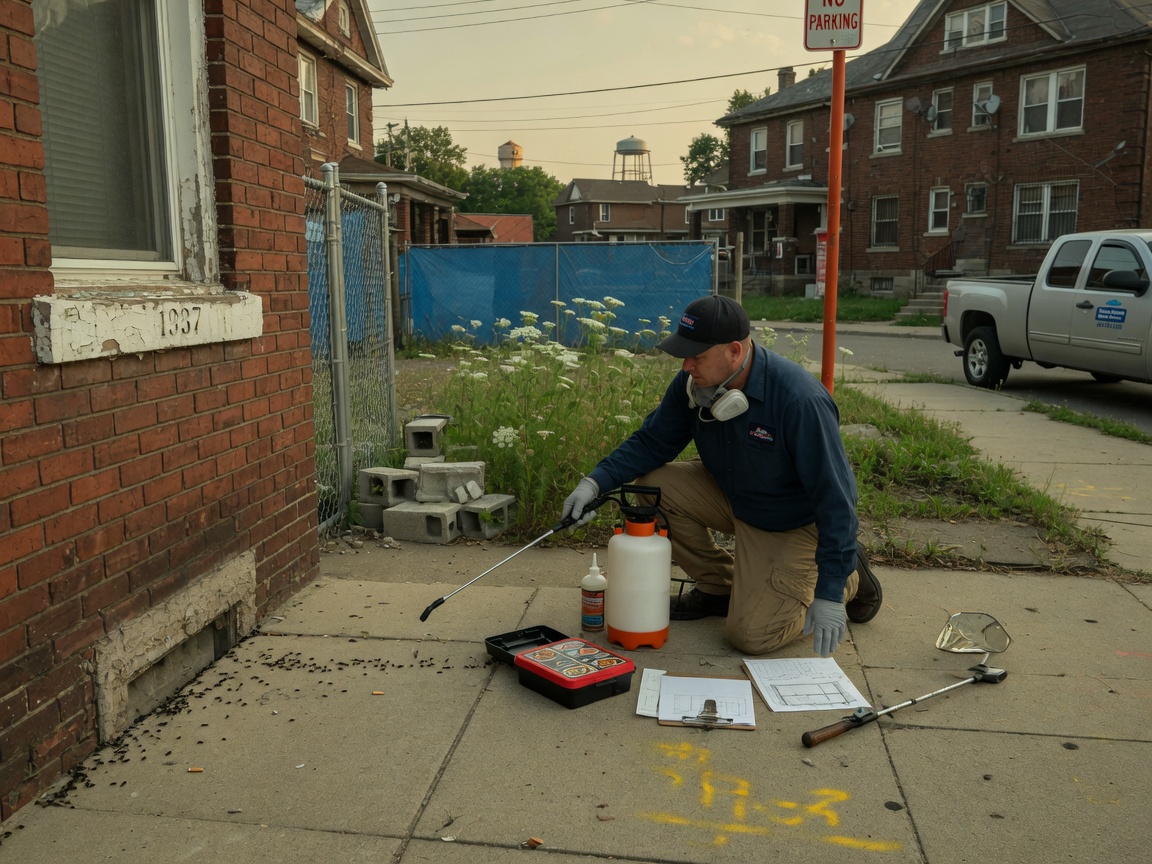
Detroit’s older housing stock in neighborhoods like Boston-Edison and Indian Village features brick foundations and crawl spaces that create persistent entry points for carpenter ants. These ants follow moisture trails from melting snow into wall voids during the shift from cold winters to warm summers. Treatments focus on locating satellite colonies rather than surface sprays that miss the main nest.
Pavement ants thrive along sidewalks and driveways in Midtown and Corktown where salt and sand from winter road maintenance create ideal nesting conditions. Baiting programs placed at active trails near Eastern Market loading areas reduce colony size without leaving residue near food vendors. Follow-up visits account for the four distinct seasons that trigger new foraging activity each spring.
Homeowners in Palmer Park and Woodbridge often see ants after heavy summer rains flood soil near basement windows. Liquid barriers applied at grade level combined with dust treatments in void spaces address both the immediate trail and the hidden nest. This approach respects the dense tree canopy and older plumbing that keep soil moisture high year-round.
Service calls in Hamtramck and Dearborn frequently involve mixed-use buildings where ants move between residential and commercial spaces through shared walls. Inspection includes checking utility entries and expansion joints that older construction leaves exposed. Targeted gel baits placed in these gaps stop the movement without disrupting business operations.
Technician insight
In Detroit the thing that catches most people out with ant control is how quickly carpenter ants move from the exterior into wall voids once snowmelt raises soil moisture around 1920s brick foundations in neighborhoods like Indian Village. Homeowners often spray trails themselves and scatter the colony deeper into the structure, making the next treatment take twice as long.
Corktown row house trail
Homeowner noticed steady pavement ant traffic along the kitchen baseboard after spring thaw. Inspection found the colony nesting under the front sidewalk where winter salt had created a gap beside the 1890s foundation. Bait stations were placed at the trail and inside the adjacent void; the colony collapsed within ten days and no new activity appeared during the follow-up check.
Ant Control Services We Offer
✓Carpenter Ant Colony Elimination
Locates and treats primary nests inside wall voids of pre-1940 homes common in Boston-Edison and Indian Village.
✓Pavement Ant Baiting Program
Places slow-acting bait stations along sidewalks and driveways in Midtown and Corktown to collapse surface colonies.
✓Indoor Ant Trail Removal
Applies non-repellent treatments along baseboards and window sills in Woodbridge and Palmer Park homes where trails appear after rain.
✓Moisture-Related Ant Prevention
Addresses entry points created by seasonal freeze-thaw cycles around foundations in Wayne County brick structures.
✓Commercial Kitchen Ant Control
Targets foraging paths near Eastern Market and Campus Martius Park food businesses without affecting daily operations.
Ant Control Cost in Detroit, MI
| Service | Typical Range | What Affects It |
|---|---|---|
| Single-family home inspection and initial treatment | $175–$325 | Higher end for multi-story homes in Boston-Edison with extensive crawl space access. |
| Follow-up visit | $95–$150 | Required when multiple satellite colonies are present after winter thaw. |
| Commercial kitchen service | $250–$450 | Covers shared-wall buildings near Eastern Market with after-hours scheduling. |
Ranges are typical for Detroit, MI and confirmed with an exact written quote before any work starts.
How it works
- 1
Initial Inspection
Technician examines foundation, crawl space, and utility entries in the specific Detroit neighborhood to map active trails and potential nest locations.
- 2
Targeted Treatment Placement
Baits and dusts are applied directly to trails and voids while avoiding high-traffic areas near Comerica Park or Belle Isle Park homes.
- 3
Follow-Up Monitoring
Return visit checks bait consumption and adjusts placement after the first seasonal temperature shift.
- 4
Prevention Recommendations
Owner receives guidance on sealing cracks typical of older Wayne County housing and managing moisture around the structure.
Pricing
Pricing based on property size, number of colonies, and access to voids in older Detroit homes.